
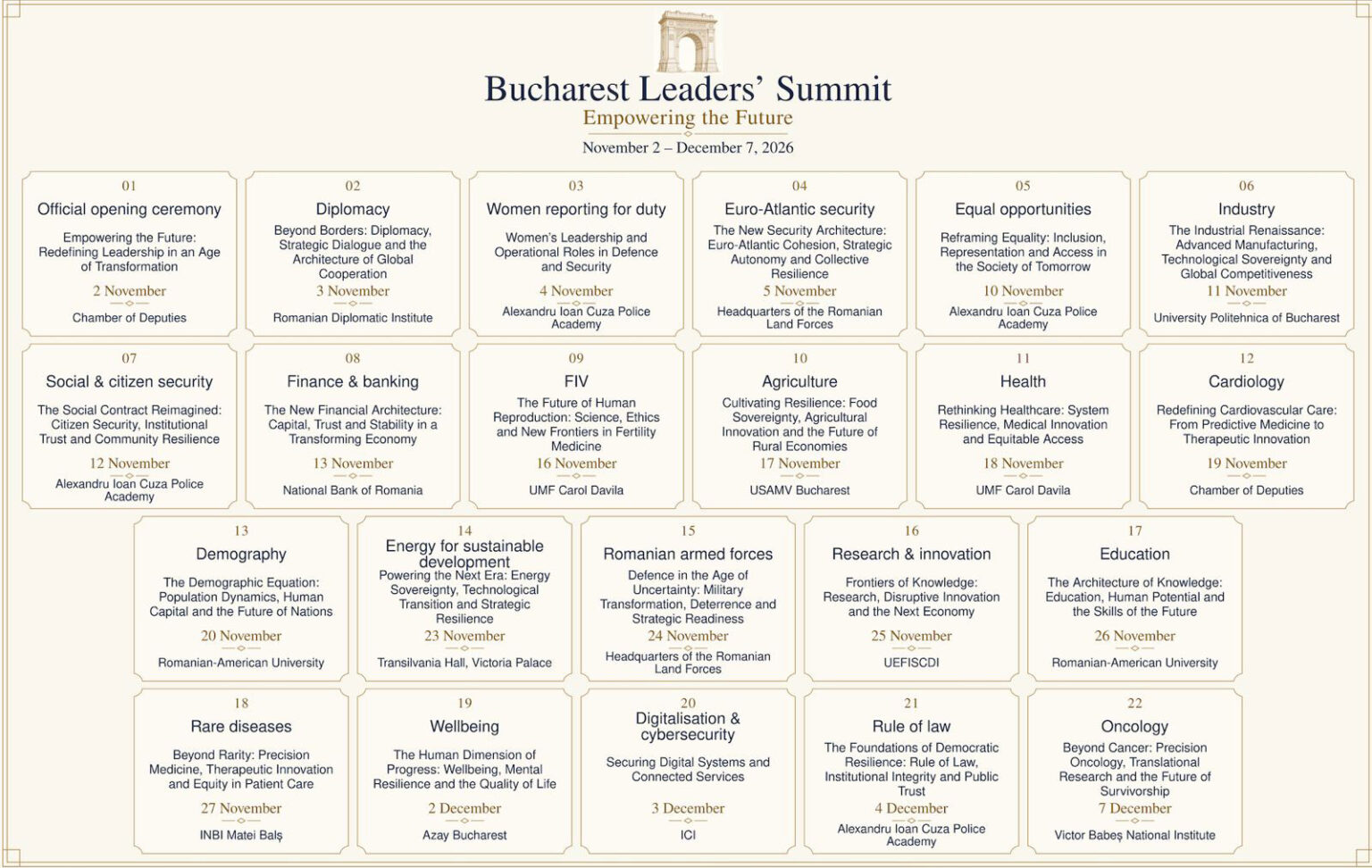
1. Official Opening
Main Theme: Building the Future: Redefining Leadership in an Age of Transformation
Subtopics and Discussion Areas:
- Leadership and responsibility in times of change
- Romania in the new geopolitical and economic context
- Economic diplomacy, investment and international partnerships
- Resilient institutions and citizens’ trust
- Sustainable development and decisions for future generations
2. Diplomacy
Main Theme: Diplomacy in a Changing World
Subtopics and Discussion Areas:
- Economic diplomacy and bilateral relations
- The role of diplomacy in regional security and stability
- Multilateralism and cooperation amid global transformations
3. Women — Reporting for Duty
Main Theme: Women in Defence, Public Order and National Security
Subtopics and Discussion Areas:
- Women’s career paths in defence, public order and security
- Leadership and participation in decision-making
- Experience in operational missions and command positions
- Education, mentoring and professional development
- Barriers, opportunities and institutional best practices
4. Euro-Atlantic Security
Main Theme: The New Security Architecture: Euro-Atlantic Cohesion, Strategic Autonomy and Collective Resilience
- Romania and the future of the Euro-Atlantic security architecture;
- strengthening NATO’s Eastern Flank and security in the Black Sea region;
- the transatlantic strategic partnership and NATO–European Union cooperation;
- enhancing national defence capabilities and modernising the Romanian Armed Forces;
- the defence industry and the development of production capabilities in Romania;
- security of critical and energy infrastructure;
- cybersecurity, artificial intelligence and new defence technologies;
- hybrid threats, disinformation and the protection of democratic societies;
- military mobility and the development of strategic infrastructure;
- cooperation among state institutions, the private sector and academia in security and resilience;
- investment in dual-use technologies and the development of Romania’s defence ecosystem;
- Romania’s role in ensuring security and stability in the Black Sea region.
5. Equal Opportunities
Main Theme: Reframing Equality: Inclusion, Representation and Access in the Society of Tomorrow
Subtopics and Discussion Areas:
- Equitable representation in leadership and decision-making
- Social inclusion and access to opportunities
- Preventing discrimination and violence
- Education, employment and economic independence
- Public policies and progress indicators
6. Industry
Main Theme: The Industrial Renaissance: Advanced Manufacturing, Technological Sovereignty and Global Competitiveness
Subtopics and Discussion Areas:
- Reindustrialisation and European competitiveness
- Supply chains and technological autonomy
- Industry 4.0, automation and artificial intelligence
- Energy, production costs and decarbonisation
- Skills development and research–industry partnerships
7. Social and Citizen Security
Main Theme: The Social Contract Reimagined: Citizen Security, Institutional Trust and Community Resilience
Subtopics and Discussion Areas:
- The social contract and trust in institutions
- Community safety and risk prevention
- Victim protection and combating human trafficking
- Integrated emergency response
- Road safety and civic responsibility
8. Finance and Banking
Main Theme: Financial Romania 2027: Vision, Innovation, Action. Business Strategies and Growth Solutions in a Complex Economic, Political and Social Climate
Proposed structure: two analytical focus sessions, one banking panel and one panel covering leasing, capital markets, insurance, academia and business.
- Romania caught in the trap of structural deficits
- What should be done to revive the economy?
- Where are inflation, exchange rates and interest rates heading?
- Banks facing an economic slowdown
- Lending dynamics under pressure from deficits
- Warning signs from the real economy
- A behavioural economics perspective on the economic situation
- Banks as an engine of recovery, not austerity: the financial and banking sector’s position on fiscal and anti-competitive decisions; the role of the Bank Deposit Guarantee Fund as an anchor of trust; business strategies of major commercial and digital banks to support individual consumers, SMEs and corporations and manage risks effectively; digitalisation and customer responses.
- Leasing as a lifeline for investment: flexible financing solutions for equipment and vehicles.
- Capital Markets (BVB): the stock exchange as an alternative driver of growth and capital raising for Romanian companies in a volatile macroeconomic environment.
- Insurance: insurance products to protect individuals and businesses, adapted to current conditions, and solutions to stimulate the market.
- Business: entrepreneurial and management solutions to generate independent growth, adapted to a complex social environment.
- Economic Higher Education: adapting university programmes and financial education to technological realities (AI, digitalisation) and labour market requirements.
9. In Vitro Fertilisation (IVF)
Main Theme: The Future of Human Reproduction: Science, Ethics and New Frontiers in Fertility Medicine
Subtopics and Discussion Areas:
- Infertility as a public health issue
- Equitable access and patient support programmes
- Clinical advances and assisted reproduction technologies
- Psychological counselling and a multidisciplinary approach
- Ethical frameworks and regulation
10. Agriculture
Main Theme: Cultivating Resilience: Food Sovereignty, Agricultural Innovation and the Future of Rural Economies
Subtopics and Discussion Areas:
- Food security and agricultural sector resilience
- Precision agriculture and digital technologies
- Climate change adaptation and water management
- Agricultural research, innovation and productivity
- Financing farms and agri-food supply chains
11. Healthcare
Main Theme: Rethinking Healthcare: System Resilience, Medical Innovation and Equitable Access
Subtopics and Discussion Areas:
- Health system resilience and crisis preparedness
- Medical innovation and digital transformation
- Equitable access to diagnosis and treatment
- Human resources and sustainable financing
- Medical data, interoperability and patient protection
12. Cardiology
Main Theme: Redefining Cardiovascular Care: From Predictive Medicine to Therapeutic Innovation
Subtopics and Discussion Areas:
- prevention and early diagnosis of cardiovascular diseases;
- predictive medicine and personalised treatment;
- innovations in interventional cardiology and cardiovascular surgery;
- artificial intelligence and digital technologies in cardiology;
- remote monitoring and the development of telemedicine services;
- management of cardiovascular emergencies;
- cardiovascular rehabilitation and continuity of care;
- cooperation among hospitals, universities, research institutes and the medical industry;
- cardiovascular health of military personnel and operational medicine.
13. Demography
Main Theme: The Demographic Equation: Population Dynamics, Human Capital and the Future of Nations
Subtopics and Discussion Areas:
- Population ageing and the sustainability of social systems
- Birth rates, families and support policies
- Migration, mobility and labour force dynamics
- Territorial disparities and depopulation
- Official statistics as a basis for public policy
14. Energy for Sustainable Development
Main Theme: Powering the Next Era: Energy Sovereignty, Technological Transition and Strategic Resilience
Subtopics and Discussion Areas:
- strengthening Romania’s energy security and sovereignty in the context of sustainable development goals;
- responsible and sustainable use of national energy resources;
- modernising critical energy infrastructure and transmission and distribution networks;
- developing energy generation and storage capacities;
- integrating renewable energy sources and ensuring power system flexibility;
- developing nuclear energy and new low-emission technologies;
- digitalising and protecting energy infrastructure;
- energy efficiency, economic decarbonisation and sustainable resource use;
- access to safe and affordable energy as an essential factor in the sustainable development of communities;
- attracting investment and strengthening cooperation among authorities, business and academia to support the energy transition and sustainable development.
15. Romanian Armed Forces
Main Theme: Defence in the Age of Uncertainty: Military Transformation, Deterrence and Strategic Readiness
Subtopics and Discussion Areas:
- transformation and modernisation of the Romanian Armed Forces in response to the evolving security environment;
- cooperation among the Land, Air and Naval Forces in joint operations;
- multidomain defence and integration of land, air, naval, cyber and space capabilities;
- strengthening deterrence and defence capabilities on NATO’s Eastern Flank;
- the role of the Land Forces in national territorial defence, military mobility and support for allied operations;
- airspace defence, military aviation development and integration of air and missile defence systems;
- maritime security, protection of freedom of navigation and the role of the Naval Forces in the Black Sea region;
- surveillance, early warning and information-sharing among the three service branches;
- lessons from contemporary conflicts and adaptation of doctrines, structures and training processes;
- battlefield digitalisation and interoperability of command, control, communications, intelligence, surveillance and reconnaissance systems;
- artificial intelligence, autonomous systems, drones and emerging military technologies;
- cybersecurity, electronic warfare and protection of military and critical infrastructure;
- development of logistics capabilities, strategic reserves and the capacity to sustain military operations;
- the national defence industry and the development of production, maintenance and innovation capabilities;
- investment in research, dual-use technologies and solutions developed with the private sector and academia;
- joint training, multinational exercises and greater interoperability with allied forces;
- recruitment, education, development and retention of military personnel;
- military leadership and training the next generation of commanders;
- operational medicine and personnel protection during military missions and operations;
- strengthening security culture and relations between the armed forces and society.
16. Research and Innovation
Main Theme: Frontiers of Knowledge: Research, Disruptive Innovation and the Economy of the Future
Subtopics and Discussion Areas:
- the role of research and innovation in enhancing Romania’s competitiveness;
- research funding and the exploitation of scientific results;
- strengthening Romania’s participation in European research and innovation programmes;
- artificial intelligence and disruptive technologies;
- technology transfer and collaboration between universities
- research institutes and companies;
- development of regional innovation ecosystems and smart specialisation;
- support for startups and the transformation of research results into products and services;
- internationalisation of Romanian research and science diplomacy;
- developing, attracting and retaining human capital in research
- aligning research funding with the needs of the economy and society;
- developing research infrastructure and access to advanced technologies
- the contribution of research and innovation to economic, social and institutional resilience.
17. Education
Main Theme: The Architecture of Knowledge: Education, Human Potential and the Skills of the Future
Subtopics and Discussion Areas:
- Skills for the economy of the future
- Artificial intelligence and digitalisation in learning
- Links between education, research and the labour market
- Equitable access and reducing dropout rates
- Lifelong learning and professional reskilling
18. Rare Diseases
Main Theme: Beyond Rarity: Precision Medicine, Therapeutic Innovation and Equity in Patient Care
Subtopics and Discussion Areas:
- Early diagnosis and reducing diagnostic delays
- Patient pathways and centres of expertise
- Genomic medicine and innovative therapies
- Patient registries and European cooperation
- Access to treatments and support for families
19. Wellbeing
Main Theme: The Human Dimension of Progress: Wellbeing, Mental Resilience and Quality of Life
Subtopics and Discussion Areas:
- Mental health and burnout prevention
- Work–life balance
- Organisational wellbeing and productivity
- Prevention, lifestyle and community health
- The role of leadership in organisational culture
20. Digitalisation and Cybersecurity
Main Theme: The Digital Future: Innovation, Cybersecurity and Resilience in a Connected World
Subtopics and Discussion Areas:
- accelerating the digital transformation of public administration and the economy;
- stimulating innovation and leveraging new technologies to enhance competitiveness;
- developing and using artificial intelligence responsibly;
- strengthening cybersecurity and the resilience of institutions and companies;
- protecting critical infrastructure and ensuring continuity of essential services;
- developing digital infrastructure and interoperability of IT systems;
- data protection and building trust in a connected world;
- developing digital skills and training specialists for the future economy;
- attracting investment and strengthening cooperation among authorities, business and academia.
21. Rule of Law
Main Theme: The Foundations of Democratic Resilience: Rule of Law, Institutional Integrity and Public Trust
Subtopics and Discussion Areas:
- Judicial independence and separation of powers
- Access to justice and protection of fundamental rights
- Integrity, transparency and public accountability
- Digitalisation of justice and institutional efficiency
- Public trust and democratic resilience
22. Oncology
Main Theme: Beyond Cancer: Precision Oncology, Translational Research and the Future of Survivorship
Subtopics and Discussion Areas:
- cancer prevention, screening and early diagnosis;
- precision oncology and personalised therapies;
- biomarkers and the use of genetic profiling to select treatments;
- immunotherapy and new generations of oncology treatments;
- translational research and integrating research findings into clinical practice;
- the role of artificial intelligence and digital technologies in diagnosis and treatment;
- oncological surgery and a multidisciplinary approach to patient care;
- equitable access to diagnosis, treatment and care;
- rehabilitation, long-term follow-up and survivors’ quality of life;
- collaboration among hospitals, universities, research institutes, authorities and the pharmaceutical industry.